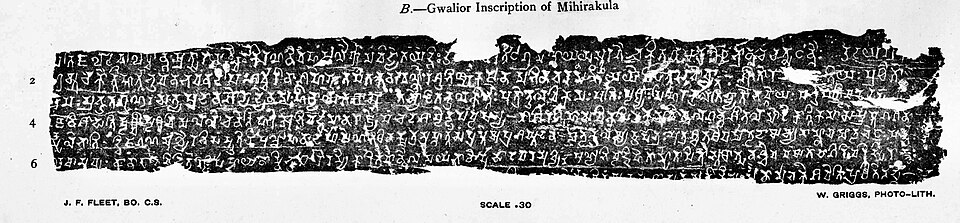
Gwalior inscription of Mihirakula
About Gwalior inscription of Mihirakula
The inscription is carved on a red sandstone slab, its text rendered in the northern class of ancient Gupta script and composed entirely in poetic verse. The stone was discovered in 1861 by Alexander Cunningham, who found it in the porch of another temple on Gwalior Fort. At that time, nine lines of text remained visible on the broken slab. Shortly after discovery, the stone was moved to the Imperial Museum at Calcutta (now the Indian Museum in Kolkata) for preservation. Over time, additional damage occurred; today only seven lines can be studied. The first two to three characters of each line were lost even before the slab's removal, making complete reconstruction of the original text impossible, though scholars including John Faithfull Fleet have published interpolated versions based on available evidence.
The Surya Temple and Its Setting
The inscription records the dedication of a stone temple to Surya, the sun god, built on Gopa hill in the month of Kārttika. The temple likely stood near the edge of a tank (water reservoir) known as Surāj Kuṇḍ within Gwalior Fort. Gopa hill is now located in the southern part of the fort. The inscription's composition in poetic verse and its focus on Surya suggest it originated within the Saura tradition of Hinduism, which centers worship on the sun deity. The original temple structure has been lost to time, leaving only this carved record of its existence and the circumstances of its construction.
Visiting the Inscription
The inscribed stone itself is not on display at Gwalior Fort but is housed in the Indian Museum in Kolkata, where it is preserved for scholarly study and public viewing. Those interested in seeing the artifact must visit the museum in Kolkata rather than travel to Gwalior. The inscription is a specialized historical document rather than an active place of worship, so a visit is suited to those with interest in early Indian epigraphy, Gupta-era history, or the development of Hindu temple traditions. The museum setting allows close examination of the carved script and the red sandstone material, though the damage to the slab is evident.
Historical Significance
This inscription is notable for its documentation of the Hūṇa period in northern India during the first half of the 6th century CE, specifically mentioning the rule of kings Toramana and Mihirakula. It provides concrete evidence of temple construction and religious patronage during the Gupta era, a period of significant cultural and architectural development in India. The text's composition in Sanskrit verse reflects the literary sophistication of the period and the integration of religious devotion with courtly culture. For scholars of Indian history, epigraphy, and the development of Hindu temple architecture, this inscription offers valuable insight into how temples were commissioned, dedicated, and commemorated in stone.
Scholarly Study and Translations
The inscription has been studied and translated by multiple scholars since its discovery. Rajendralal Mitra published the first interpretation and translation in 1862, followed by John Faithfull Fleet's interpolated version and reconstructed translation in 1888. Later scholars including Bhandarkar, Garde, Dvivedī, Willis, and D. C. Sircar have included the inscription in their epigraphic lists and editions. These various translations and studies are available through academic sources and museum documentation, making the inscription accessible to those researching early Indian temple history and Sanskrit epigraphy.
How to reach
You may also visit
Sureshwari Devi Temple
Sureshwari Devi Temple in Haridwar is a forest shrine dedicated to the goddess, situated within the Ranipur Range area near Rajaji National Park, offering a secluded spiritual e…
Agatheeswarar Temple, Karur
Agatheeswarar Temple in Thirumukkudalur, Karur district, is an ancient Hindu shrine dedicated to Shiva, situated at the sacred confluence of three rivers and believed to be over…

Shani Shingnapur
Shani Shingnapur is a renowned temple in Maharashtra dedicated to Lord Shani, featuring a self-emerged black stone idol worshipped under open sky. The temple is located in a uni…

Kamaksha
Arulmigu Kamakshi Amman Temple in Mangadu, near Chennai, is dedicated to the goddess Kamakshi, an aspect of Adi Parashakti. According to legend, the goddess performed austeritie…
Guhaditya temple
Guhaditya temple in Dwarka is an ancient shrine dedicated to the sun deity, established over 150 years ago. Pilgrims enter through the Swarg Dwar (Gateway to Heaven) and exit vi…
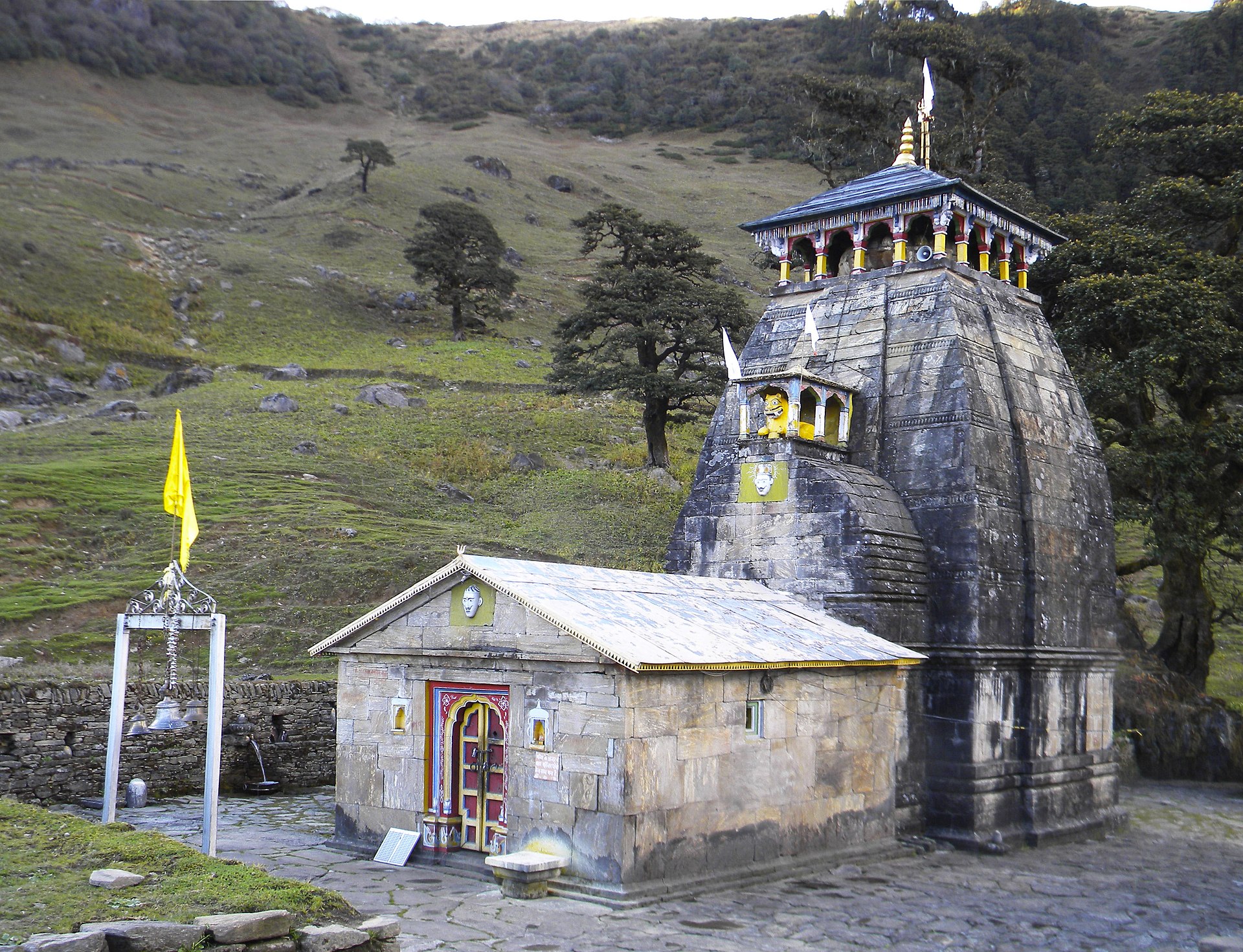
Madhyamaheshwar Temple
Madhyamaheshwar Temple is one of the five sacred Shiva shrines in the Panch Kedar pilgrimage circuit, located in the Garhwal Himalayas of Uttarakhand. Each temple in the circuit…